
An honest breakdown of dental implant costs, materials, and clinical factors influencing your tooth restoration investment in Bangalore.
When considering replacing missing teeth, understanding the overall financial commitment is a vital step in making an informed decision. While modern dental implants require a higher upfront investment compared to conventional dental bridges or removable dentures, their exceptional longevity makes them the most cost-effective solution over time. Many patients seeking permanent tooth replacement in Bangalore often wonder about the specific factors that shape these treatment costs.
At Maxface Dental Clinic, we prioritize absolute financial transparency and clinical excellence for all our patients. By analyzing the structural components, clinical requirements, and brand specifications, we help patients understand what to expect. This comprehensive guide outlines the exact clinical and diagnostic elements that determine the final cost of implant restorations.
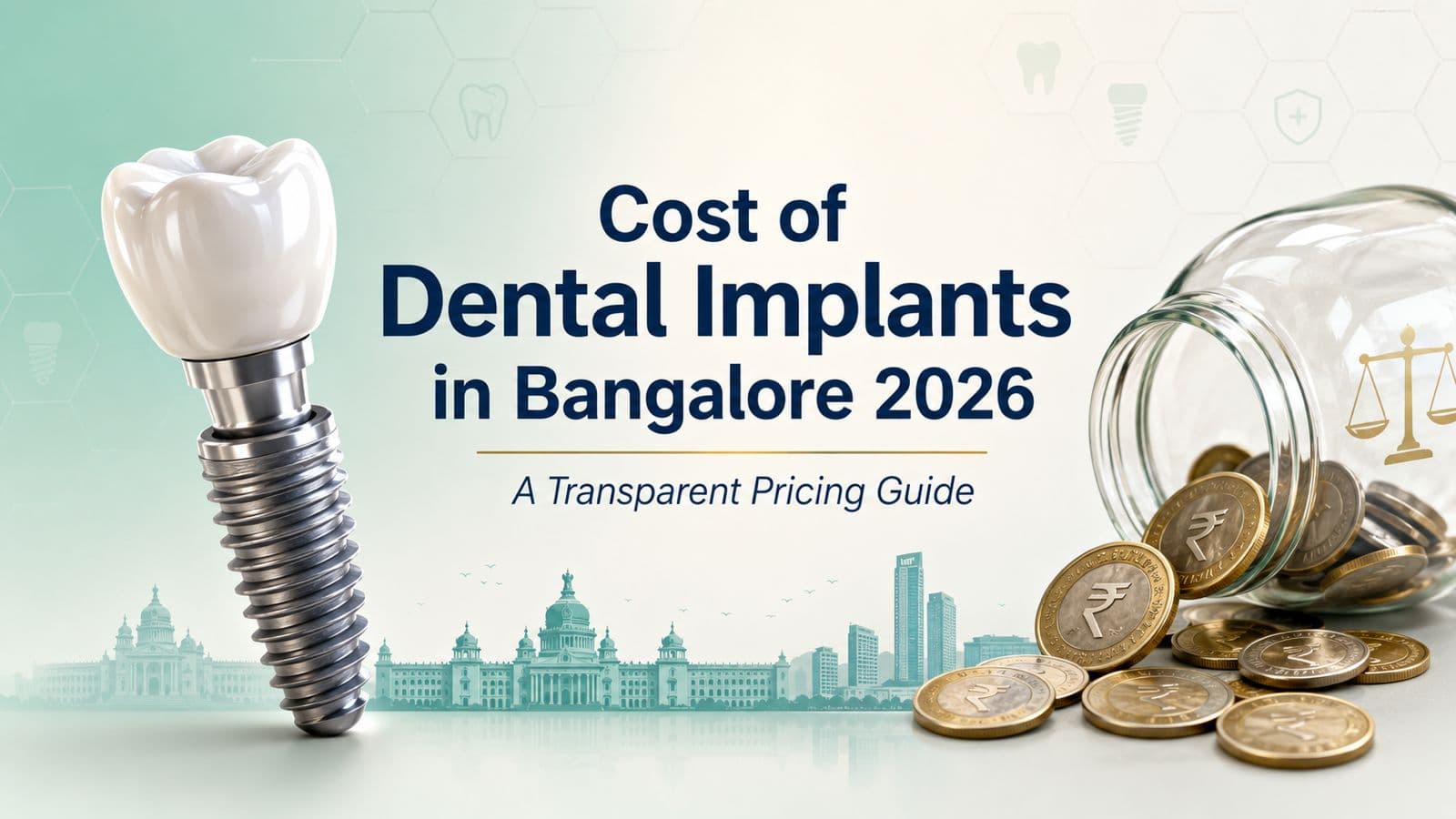
The dental implant cost in Bangalore typically ranges from INR 25,000 to INR 65,000 per implant, depending on the brand and clinical requirements. This price bracket usually covers the surgical titanium post, the connecting abutment, and the prosthetic crown. However, the precise price for a single tooth replacement or a comprehensive full mouth rehabilitation depends entirely on the unique oral anatomy of the patient.
A standard single-tooth implant procedure requires a healing period of 3 to 6 months for osseointegration, which is the process of the titanium post fusing with the bone. During this time, the implant establishes a stable foundation that mimics a natural tooth root. Because this treatment is highly customized, an accurate cost estimation can only be determined after a clinical examination.
Patients should note that some clinical cases require additional diagnostic steps or tissue preparation, which can modify the base price. While budget implants exist, selecting certified international systems prevents costly complications and ensures a high success rate. Investing in premium systems provides long-term peace of mind and reduces the likelihood of future corrective surgeries.
The primary clinical factors influencing your total dental implant treatment cost include implant brand selection, jawbone density, diagnostics, and customized prosthetics. Every patient presents a unique anatomical profile that dictates the complexity of the surgical placement. Therefore, a cookie-cutter pricing model is rarely applicable in advanced implantology. Understanding these individual variables helps patients evaluate the value of their treatment plans.
Premium implant brands affect final costs due to their specialized titanium alloys, surface treatments, and extensive scientific research. Leading international systems like Nobel Biocare, Straumann, and Osstem have documented success rates exceeding 98.2% in long-term clinical trials. These manufacturers use high-grade Grade 5 titanium or zirconia, which are highly biocompatible and encourage rapid bone integration.
Choosing a reputable brand ensures that the implant components are manufactured with micrometer-level precision. This precision minimizes the risk of micro-movements, which are a primary cause of early implant failure. Furthermore, premium manufacturers offer lifetime global warranties, meaning replacement parts are easily accessible anywhere in the world.
Advanced diagnostic imaging, such as a 3D CBCT scan, is required for precise implant placement and safety planning, adding a baseline diagnostic fee to the treatment. Unlike traditional flat X-rays, a Cone Beam Computed Tomography (CBCT) scan provides a detailed three-dimensional view of your jawbone architecture. This technology allows the implantologist to measure bone height and width with 0.1mm accuracy.
Using these 3D scans, specialists can map the exact pathway of sensory nerves and maxillary sinuses. This digital mapping prevents accidental nerve injury and ensures the implant is placed in the optimal biomechanical position. While a CBCT scan represents an upfront cost, it dramatically enhances surgical safety and long-term treatment predictability.
Preparatory procedures like bone grafting or sinus lifts are necessary when jawbone volume is insufficient, which adds to the overall implant treatment cost. When a tooth is missing for several months, the surrounding jawbone naturally resorbs, losing up to 25% of its volume in the first year alone. If the bone is too thin or soft, it cannot securely support a titanium post.
In such cases, the clinician must perform a bone graft using specialized bone substitute materials to rebuild the ridge. For the upper back teeth, a sinus lift may be required to gently elevate the sinus membrane and place bone graft material underneath. These preparatory steps require an additional 3 to 6 months of healing but are vital for a stable foundation.
For patients with severe bone loss in the upper jaw, alternative solutions like zygomatic implants may be recommended. These longer implants anchor directly into the cheekbone, bypassing the need for extensive bone grafting. While zygomatic procedures involve higher initial costs, they provide a fast, graftless option for complex rehabilitations.
The choice of prosthetic crown material, such as zirconia or metal-ceramic, directly impacts the final cost and durability of the restoration. The crown is the visible portion of the implant that restores your chewing function and facial aesthetics. Modern dental laboratories fabricate these crowns using computer-aided design and manufacturing (CAD/CAM) technology for a perfect fit.
Solid zirconia crowns represent the premium tier, offering exceptional fracture resistance and a lifelike, translucent appearance. In contrast, porcelain-fused-to-metal (PFM) crowns are slightly more affordable but may show a dark metal line near the gumline over time. Choosing zirconia ensures that the restoration shaves less than 0.3mm of clearance issues and withstands high chewing forces.
Comparing dental implants to traditional bridges and dentures reveals that implants offer a lower long-term cost due to their high durability. Traditional dental bridges require grinding down adjacent healthy teeth, removing up to 50% of their natural enamel structure. This alters healthy teeth permanently and makes them vulnerable to decay, often requiring root canal treatments later.
Removable dentures, while inexpensive initially, frequently require refitting, relining, or replacement every 5 to 7 years due to ongoing bone resorption. This continuous bone loss alters your facial structure, leading to a prematurely aged appearance and reduced chewing efficiency. Over a 15 to 25 year period, the repetitive costs of maintenance and replacements exceed the price of a single implant.
An implant acts as an independent structure that preserves adjacent teeth and actively stimulates the jawbone to prevent resorption. This biological preservation is a major health benefit that cannot be measured in monetary terms alone. Consequently, the initial investment in an implant translates into decades of hassle-free oral health.
The long-term value of dental implants is defined by their outstanding 98.2% success rate, bone-preserving benefits, and lifetime durability. Unlike other tooth replacement options that eventually fail, a properly integrated titanium implant can last a lifetime with good oral hygiene. This makes the cost per year of an implant remarkably low compared to temporary fixes.
Beyond the structural benefits, implants restore your natural chewing capacity to 100%, allowing you to enjoy a complete and healthy diet. This improvement in nutrition and speech quality has a direct positive impact on your systemic health and self-confidence. When you choose a certified specialist, you are investing in a predictable, scientifically backed medical treatment.
To discuss dental implant cost with Dr. Srinivas, book a consultation at Maxface Dental Clinic, Bangalore.
The cost variation is primarily driven by the quality of the titanium alloy, the surface treatments that enhance bone fusion, and the level of scientific research backing the brand. Premium global brands offer lifetime warranties and have documented success rates of over 98.2%, making them a safer long-term investment. Budget brands may lack extensive clinical backing, increasing the risk of early implant failure.
Generally, 3D CBCT scans and initial diagnostic assessments are billed separately from the core implant placement fee. These scans are critical for evaluating your jawbone density and mapping nerve pathways to ensure high surgical precision. A clear diagnostic plan prevents unexpected complications during your treatment journey.
Bone grafting is only required if your jawbone has deteriorated due to tooth loss and cannot securely support the implant post. This preparatory procedure involves an additional fee due to the cost of bone substitute materials and the specialized surgical technique required. If your bone structure is healthy, you can proceed directly to implant placement without grafting.
Medically Reviewed By
MDS Prosthodontics, Fellow & Diplomate ICOI (USA) · Chief Implantologist · Last updated: May 2026
Dr. B. Srinivas Rao co-authored the landmark 1st Global Consensus for Clinical Guidelines on rehabilitating the completely toothless upper jaw — published in Clinical Oral Implants Research, 2026.
A systematic review co-authored by Dr. B. Srinivas Rao evaluating whether high-performance polymers PEEK and PEKK can serve as viable alternatives to metal frameworks in complete-arch implant-supported fixed dental prostheses.
A finite element analysis comparing stress distribution patterns in implant-supported fixed dental prostheses made with zirconia and PEEK frameworks — revealing how material choice impacts long-term implant health.