
Compare dental implants, fixed bridges, and removable dentures on durability, chewing efficiency, and bone health to choose the best option for your smile.
Understanding tooth loss is critical because losing teeth impairs your chewing ability, speech clarity, and jawbone density. Today, dental science offers three main options to replace missing teeth: dental implants, fixed dental bridges, and removable dentures. Here, we compare these treatments to help you choose the best option for your health.
Missing teeth lead to progressive jawbone resorption, which can reach up to 25% of bone volume in the first year alone. When a tooth root is lost, the surrounding bone no longer receives the mechanical stimulation required to maintain its density. Over time, this bone loss causes adjacent teeth to shift, changes your facial profile, and can lead to premature aging. Addressing tooth loss early with an appropriate restoration is critical to preserving your remaining dentition and facial aesthetics.
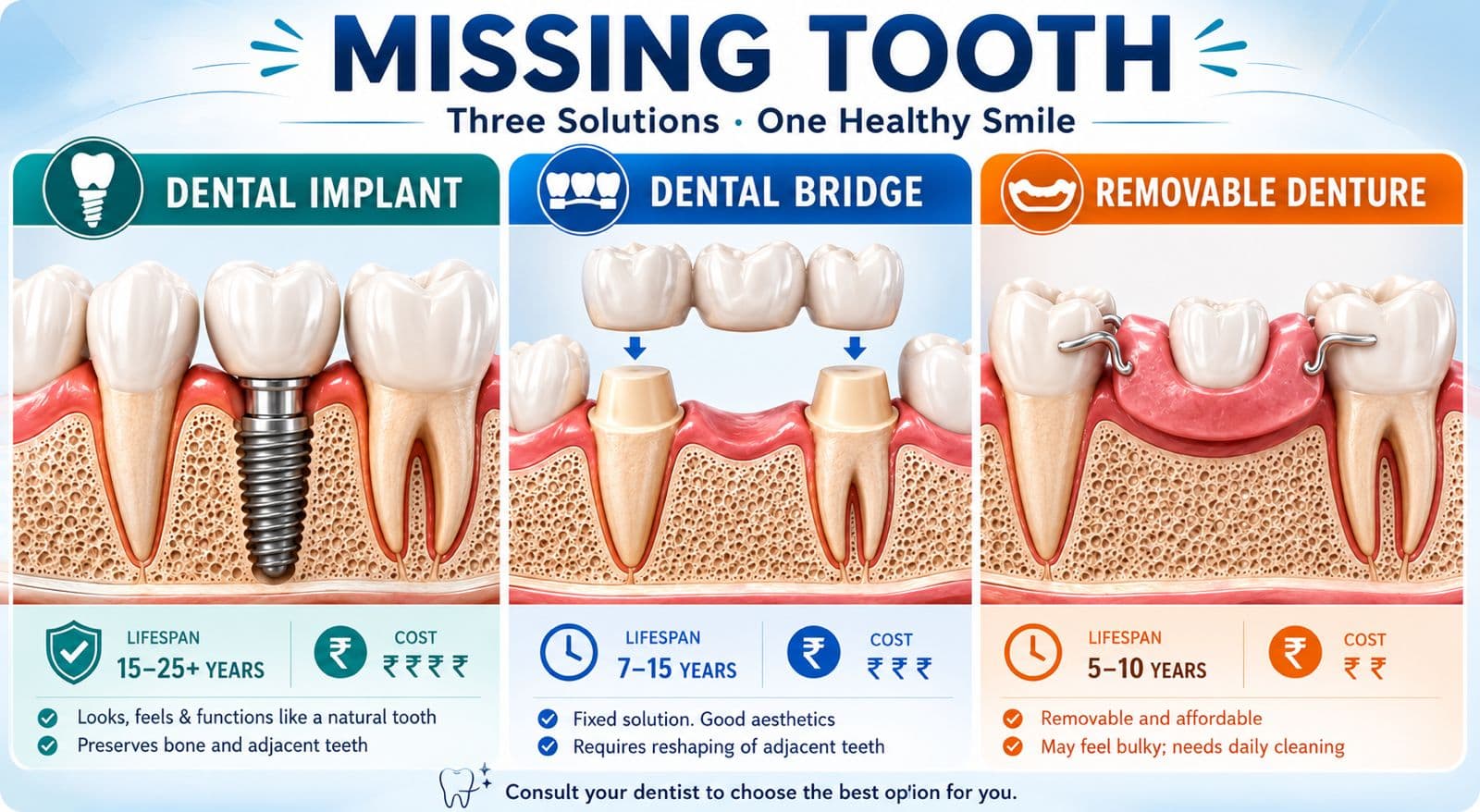
Dental implants represent the modern gold standard of tooth replacement because they replicate the entire structure of a natural tooth, from root to crown. A biocompatible titanium post is surgically placed into the jawbone, where it undergoes osseointegration, fusing with the bone over a period of 3 to 6 months. This permanent anchor achieves a success rate of 98.2% and provides a stable foundation for a custom crown. By functioning like a natural tooth root, implants stimulate the surrounding bone and prevent the resorption that typically follows tooth loss.
The primary benefits of dental implants include lifetime durability, complete preservation of adjacent teeth, and a natural appearance. Unlike other options, implants require no modification of neighboring teeth, preserving their natural enamel and structure. They restore 100% of natural chewing efficiency, allowing patients to maintain a normal diet without restrictions. With proper hygiene and regular clinical checkups, dental implants can last a lifetime, making them a highly cost-effective long-term investment.
For patients undergoing complex cosmetic restorations, implants can be integrated into a customized Smile Makeover plan. This approach allows for a unified aesthetic and functional enhancement of the entire mouth. By replacing missing teeth while enhancing the appearance of remaining ones, patients achieve comprehensive rejuvenation. The result is a harmonious, stable smile that improves self-confidence and overall oral health.
The main limitations of dental implants are the higher upfront cost and the requirement for a surgical procedure with adequate bone density. Patients must undergo a surgical placement and wait several months for osseointegration before the final crown is attached. In cases of severe bone loss, preliminary procedures like bone grafting or sinus lifts may be necessary, extending the treatment timeline.
However, for patients seeking advanced alternatives, options like zygomatic implants may bypass the need for traditional bone grafts. These specialized implants anchor directly into the cheekbone, offering immediate support even with extreme bone loss. This advanced procedure requires significant clinical expertise but dramatically expands eligibility for implant treatments. Discussing these options with a qualified specialist will clarify if surgical modifications are required for your case.
A fixed dental bridge is a non-removable prosthesis that uses healthy adjacent teeth as anchors to suspend an artificial tooth across a gap. The neighboring teeth, known as abutments, must be shaved down to accommodate the crowns that support the bridge. While bridges offer a faster restoration timeline than implants, they require removing approximately 1.5mm of healthy enamel from support teeth. This option does not address jawbone resorption beneath the missing tooth, meaning the bone in the gap will continue to shrink.
The key advantages of fixed dental bridges are a rapid treatment process and a lower initial cost compared to dental implants. A bridge is typically completed in just two clinical visits over a span of 10 to 14 days. It offers a stable, non-removable solution that restores approximately 70% to 80% of natural chewing efficiency. This makes bridges a popular choice for patients who prefer to avoid surgery or need a swift restoration.
The primary disadvantages of fixed dental bridges include the structural compromise of healthy adjacent teeth and a limited lifespan. Grinding down neighboring teeth makes them susceptible to decay and nerve damage, which might eventually require a Root Canal Treatment. Additionally, because fixed bridges do not prevent bone loss, a visible gap can form under the bridge over time, complicating oral hygiene. Most fixed dental bridges require replacement every 10 to 15 years due to wear, decay, or support tooth failure.
Removable dentures are dental appliances designed to replace multiple missing teeth or an entire arch, resting directly on the gum tissue. They are held in place by natural suction, dental adhesives, or metal clasps attached to remaining teeth. While they are the most affordable treatment option upfront, dentures do not stop bone loss and actually accelerate bone resorption due to the constant pressure on the gums.
The main pros of removable dentures are their low upfront cost, non-invasive nature, and rapid delivery time. Dentures do not require surgery, making them suitable for patients with systemic health conditions or insufficient bone structure. They provide immediate aesthetic improvement and restore basic speech and chewing functions at a fraction of the cost of fixed alternatives. This makes them a highly accessible entry-level option for replacing multiple teeth.
The significant cons of removable dentures include low chewing efficiency, instability, and the need for frequent adjustments. Dentures restore only 20% to 30% of natural chewing power, which can restrict dietary choices and impact nutrition. They are prone to slipping during speech or eating, which can cause discomfort, mucosal sore spots, and social anxiety. Because the jawbone naturally shrinks without tooth roots, dentures require frequent relining and must be replaced every 5 to 8 years.
Selecting the right tooth replacement option requires comparing durability, impact on oral health, and overall lifetime cost. The following table summarizes how dental implants, fixed bridges, and removable dentures compare across key clinical criteria:
| Criteria | Dental Implants | Fixed Dental Bridges | Removable Dentures |
|---|---|---|---|
| Durability | Lifetime (fuses with bone) | 10 to 15 years | 5 to 8 years (needs refits) |
| Bone Health | Prevents bone resorption | Does not prevent bone loss | Accelerates bone loss |
| Adjacent Teeth | Preserved completely | Must grind down healthy teeth | Clasps can damage teeth |
| Chewing Efficiency | 100% efficiency | 70% to 80% efficiency | 20% to 30% efficiency |
| Relative Lifetime Cost | Lowest (lifetime solution) | Medium (recurring replacements) | High (refits and adhesives) |
Evaluating these criteria shows that while dental implants require a higher initial investment, they preserve biological structures and offer superior function. In contrast, bridges and dentures carry recurring replacement costs and lead to ongoing bone loss. For patients missing an entire arch of teeth, these options can be integrated into a comprehensive Full Mouth Rehabilitation to restore function and confidence.
To discuss tooth replacement options with Dr. Srinivas, book a consultation at Maxface Dental Clinic, Bangalore.
Dental implants are the most durable option because they fuse directly with the jawbone through osseointegration. With proper maintenance and hygiene, implants achieve a success rate of 98.2% and are designed to last a lifetime. In contrast, fixed bridges last 10 to 15 years, while dentures typically require replacement or relining every 5 to 8 years.
Yes, fixed dental bridges require reshaping and shaving down neighboring healthy teeth to serve as support anchors. This process removes approximately 1.5mm of natural enamel, making these support teeth more vulnerable to decay and future root canals. Dental implants, conversely, do not touch or alter the adjacent teeth in any way.
Dentures become loose because the jawbone naturally shrinks and resorbs when it is no longer stimulated by natural tooth roots. This continuous bone loss changes the shape of your gums, causing the denture to lose its fit and slip. Dental implants prevent this resorption by acting as artificial roots that stimulate and preserve the jawbone.
Medically Reviewed By
MDS Prosthodontics, Fellow & Diplomate ICOI (USA) · Chief Implantologist · Last updated: May 2026
Demystifying the surgical dental implant placement process, detailing clinical diagnostics, anesthesia options, recovery timelines, and long-term care.
Understanding the step-by-step process of combining dental implants, crowns, and bite corrections to restore a collapsed bite.
Dr. B. Srinivas Rao co-authored the landmark 1st Global Consensus for Clinical Guidelines on rehabilitating the completely toothless upper jaw — published in Clinical Oral Implants Research, 2026.