
How zygomatic implants bypass the need for extensive bone grafting by anchoring directly into the cheekbone.
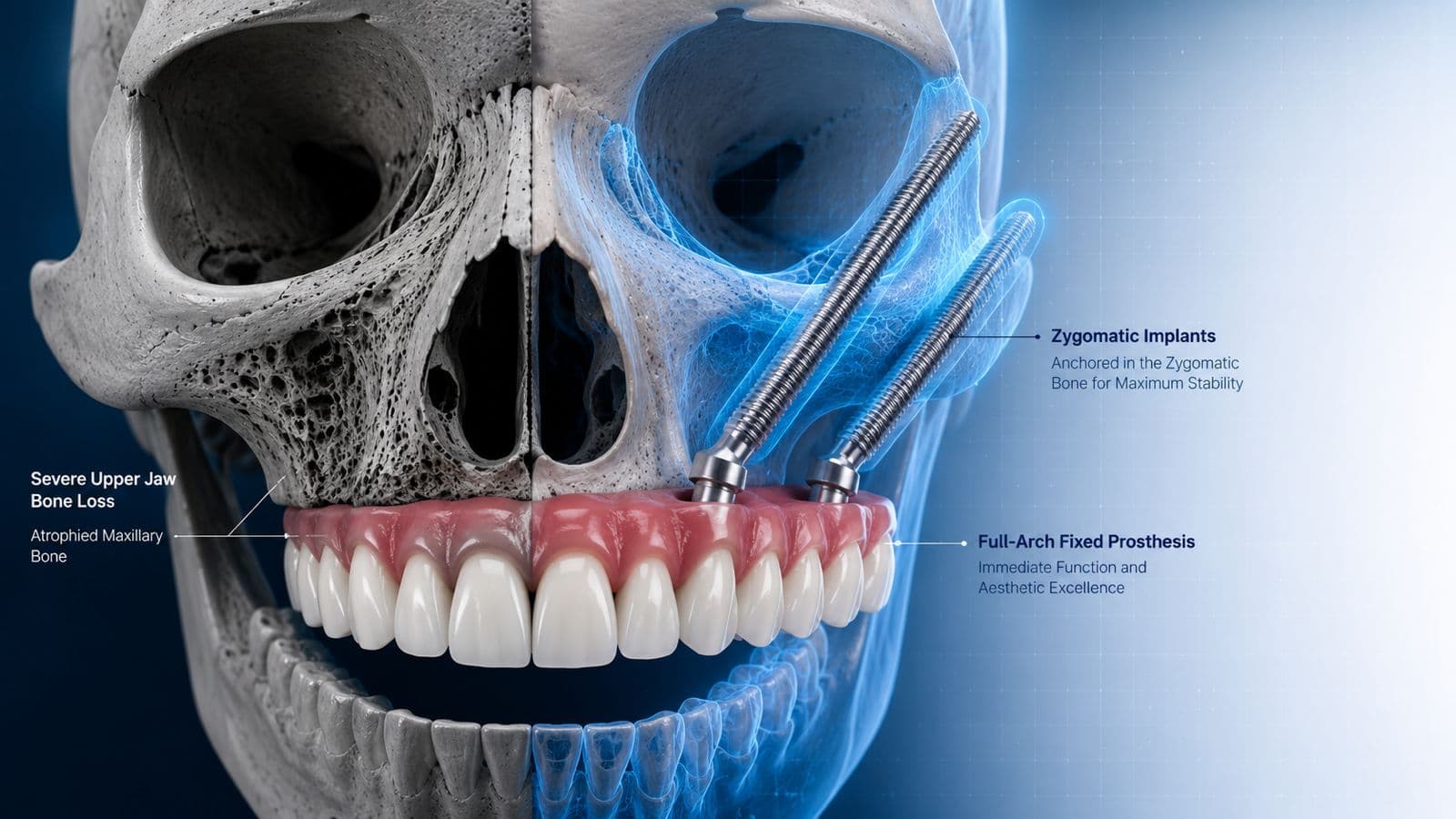
To resolve extreme bone loss, Zygomatic Implants are specialized, extra-long dental implants designed to anchor directly into the cheekbone. When teeth are missing, the surrounding alveolar bone lacks stimulation and resorbs naturally. Over 10 to 15 years of wearing traditional loose dentures, this bone loss can become severe, leaving the upper jaw with insufficient structure to support standard implants.
Without sufficient bone height and width, traditional implants cannot achieve the stability needed to withstand chewing forces. Zygomatic implant technology offers a highly reliable alternative for patients who have been told they are ineligible for standard implants. By utilizing the cheekbone instead of the jawbone, this approach provides a stable foundation even in the most challenging cases of atrophy.
Patients can regain full chewing efficiency and speech clarity without undergoing extensive bone reconstruction. This technique represents a major milestone in modern restorative dentistry, offering hope to those with severe jaw deterioration.
Zygomatic implants bypass the need for extensive bone grafting by anchoring into the dense zygomatic bone, which does not resorb like the maxillary jawbone. Traditional methods for restoring a severely atrophic upper jaw usually involve bone grafts harvested from the hip or tibia. These procedures require multiple surgical sites, raise the risk of complications, and require a healing period of 6 to 9 months before implants can be placed.
In contrast, cheekbone implants completely avoid these preparatory surgeries by taking advantage of the stable cheekbone anatomy. Zygomatic implants are significantly longer than traditional implants, typically ranging from 35mm to 55mm in length, compared to standard 8mm to 15mm posts. These extra-long titanium posts are placed at an angle, passing through the resorbed sinus cavity to anchor firmly into the cortical bone of the zygoma.
Because the zygomatic bone is highly dense and remains structurally intact, it offers an exceptionally secure anchor point. This specialized placement allows maxillofacial surgeons to achieve excellent primary stability immediately. By avoiding bone grafts, patients experience less post-operative swelling and discomfort, leading to a much faster recovery.
The primary benefit of cheekbone anchorage is the elimination of invasive sinus lifts and bone grafts, which reduces treatment timelines and surgical visits. Traditional implant methods for severe bone loss often require 2 to 3 separate surgical procedures spread over more than a year. Zygomatic implants streamline this process, allowing patients to complete their restoration with fewer visits and significantly less discomfort.
This advanced approach reduces total surgical interventions, making it an excellent choice for patients seeking a less invasive path to smile restoration. In addition to reducing physical trauma, it minimizes the psychological stress associated with prolonged dental treatments. The stability provided by the cheekbone also ensures that the final prosthetic teeth feel secure and function naturally.
Furthermore, this method reduces total treatment visits by up to 50%, making it highly convenient for busy patients. By eliminating the unpredictable healing phases of bone grafts, the entire clinical pathway becomes more predictable. Maxillofacial surgeons can plan the restoration with greater precision, ensuring consistent and stable long-term outcomes.
Immediate functional loading allows patients to receive a temporary fixed prosthetic bridge on the very same day of the surgical procedure. During the surgery, the implants are placed with a high primary stability torque of over 45 Ncm. This high insertion torque prevents micromovements, which is crucial for successful osseointegration when immediate load is applied.
With immediate loading, patients do not have to endure months of wearing loose, uncomfortable temporary dentures. They walk out of the clinic with a secure, non-removable set of teeth that allows them to speak and eat immediately. This same-day transformation provides an immediate boost to self-esteem and quality of life.
The temporary bridge remains in place during the healing and osseointegration period of 3 to 6 months. Once the implants have fully integrated with the cheekbone, the temporary bridge is replaced with a custom-designed, long-lasting final prosthesis. This transition ensures that the final teeth are perfectly aligned with the patient's healed gum tissue.
Clinical studies show that zygomatic implants have an exceptional long-term survival rate of 97.8% over a ten-year observational period. This high success rate makes them one of the most reliable solutions in modern implantology. Unlike bone grafts, which can resorb unpredictably over time, the dense zygomatic bone provides a stable, permanent foundation.
These specialized implants are designed to last 15 to 25 years or even a lifetime when maintained with proper oral hygiene and regular clinical checkups. Because they bypass the atrophic jaw areas, they are less susceptible to the localized bone loss that can threaten traditional implants. This long-term predictability provides patients with peace of mind and a lasting return on their investment.
Ideal candidates for zygomatic implants are individuals experiencing severe maxillary resorption, failed traditional implants, or severe bone loss from ectodermal dysplasia. Many patients seeking this treatment have previously been told that they cannot receive Dental Implants due to a lack of jawbone. Others may have experienced failed sinus lifts or implant failures that left them with even less usable bone structure.
This procedure is also suitable for patients who require a Full Mouth Rehabilitation due to trauma or congenital defects. It is an excellent option for individuals who want to replace loose, unstable dentures with a permanent, non-removable solution. However, candidates must be in good general health, with controlled systemic conditions and no active periodontal disease.
A thorough medical evaluation is necessary to confirm candidacy and plan the surgical approach. During this evaluation, the surgeon will assess the patient's bone structure, medical history, and aesthetic goals. This detailed screening process ensures that only suitable candidates proceed to surgery, maximizing the safety of the procedure.
The treatment journey for zygomatic implants involves a comprehensive three-step process: digital 3D diagnostics, surgical placement under anesthesia, and final prosthetic restoration. The entire process is carefully coordinated by a specialized team to ensure patient comfort and safety. From the initial consultation to the final fitting, every step is tailored to the patient's unique anatomy.
This structured pathway ensures that patients are fully informed and prepared at every stage of their treatment. By using advanced digital technology, the clinical team can minimize surgical time and optimize implant placement. The result is a highly predictable, efficient process that delivers beautiful, functional results.
Digital diagnostics begin with a high-resolution Cone Beam Computed Tomography (CBCT) scan to map the patient's facial skeleton in three dimensions. This scan allows the surgeon to visualize the exact thickness and density of the zygomatic bone. Using advanced implant planning software, the surgical team simulates the precise angle and depth of each implant.
This digital workflow eliminates guesswork and allows for the creation of custom surgical guides. These guides direct the drills and implants into the exact pre-planned positions during surgery. This level of precision is essential for avoiding vital structures like the orbits and nasal cavity.
Surgical placement of the implants is performed under general anesthesia or deep conscious sedation to ensure a completely pain-free experience. The surgeon makes small incisions in the gum tissue to access the upper jaw and zygomatic bone. Using the custom surgical guides, the surgeon prepares the implant sites and inserts the 35mm to 55mm zygomatic posts.
Depending on the extent of bone loss, the surgeon may place two zygomatic implants combined with standard implants, or four zygomatic implants (quad zygoma). Once the implants are securely anchored, multi-unit abutments are attached. These abutments serve as the connectors between the implants and the prosthetic teeth.
The temporary prosthetic bridge is then secured to the abutments, and the surgical sites are closed. The entire surgical procedure typically takes between 2 and 3 hours to complete. After a short recovery period, the patient is discharged with their new, functional smile.
Osseointegration is the biological process where the bone cells fuse directly with the titanium surface of the implants over a period of 3 to 6 months. During this healing phase, patients follow a soft-food diet to avoid placing excessive stress on the healing implants. The clinical team monitors the healing process through regular checkups.
Once osseointegration is complete, the temporary bridge is removed, and final digital impressions are taken. These impressions are sent to a dental laboratory, where the final, high-strength prosthetic bridge is fabricated. This final restoration is typically reinforced with a titanium framework for maximum durability.
The final bridge is screwed securely onto the implants, providing a beautiful, permanent smile that functions like natural teeth. This completion of the treatment journey marks the beginning of restored confidence and dietary freedom. The patient can once again enjoy their favorite foods and smile without hesitation.
To discuss zygomatic implants with Dr. Srinivas, book a consultation at Maxface Dental Clinic, Bangalore.
Yes, zygomatic implants are highly safe and possess an outstanding clinical success rate of 97.8% over ten years. They are placed by experienced maxillofacial surgeons under precise 3D digital guidance to protect surrounding anatomical structures. The dense cheekbone provides a highly stable, predictable foundation that resists bone resorption over time.
Initial healing of the gum tissue takes about 7 to 10 days, while complete osseointegration with the cheekbone takes between 3 to 6 months. Thanks to immediate functional loading, patients receive a temporary fixed bridge on the day of surgery, allowing them to eat and speak normally during recovery. Post-operative swelling and discomfort are minimal compared to traditional bone grafting procedures.
Yes, severe upper jawbone loss is the primary clinical indication for choosing zygomatic implants. Because they anchor into the zygomatic bone rather than the jawbone, they do not require any bone volume in the upper jaw. This makes them an ideal solution for patients who were previously told they cannot receive traditional dental implants.
Medically Reviewed By
MDS Prosthodontics, Fellow & Diplomate ICOI (USA) · Chief Implantologist · Last updated: May 2026
A clinical case series by Dr. B. Srinivas Rao demonstrating how patients with severely resorbed jawbones — previously told they cannot receive implants — were successfully rehabilitated using zygomatic implants and the All-on-4 treatment concept.
Find the best dental implant clinic in Bangalore. Maxface Clinic offers Sweden-trained prosthodontic expertise and 3D digital implant planning.
Zygomatic implants in Bangalore offer a graftless solution for severe upper jawbone loss. Learn how Dr. Srinivas Rao provides immediate fixed teeth.